 comparison
Professional Quartz Countertop Restoration Services Reviewed
Last Updated: November 1, 2026
Quick Summary
Professional quartz countertop restoration repairs chips, scratches, dull finishes, stains, and failed seams in place, without removing the slab. A technician assesses the damage, matches resin to the slab's color and pattern, then sands and polishes the patch to blend into the surrounding finish. Surface damage is almost always repairable at a fraction of replacement cost.
- Quartz is roughly 90 percent ground stone bound with resin, which limits what repair can achieve.
- Deep cracks through the slab and heat damage from hot pans often cannot be reliably repaired.
- Chip repair builds color-matched resin in thin layers, curing and polishing between stages.
- Dull quartz is usually caused by abrasive cleaners, not daily wear, and is fixed by mechanical polishing.
- Ask providers for two quartz-specific before-and-after photos and the name of the sealer they use.
Table of Contents
- What Professional Quartz Countertop Restoration Services Actually Fix
- Quartz Countertop Repair Cost: What Drives the Number
- Quartz Countertop Chip Repair: What a Real Fix Looks Like
- Dull Quartz Countertop Repair: Bringing the Finish Back
- Quartz Countertop Stain Removal and Seam Work
- Repair or Replace? A Decision Framework for Quartz
- How the Leading Restoration Providers Compare
- Get Your Free On-Site Estimate
- Frequently Asked Questions
What Professional Quartz Countertop Restoration Services Actually Fix
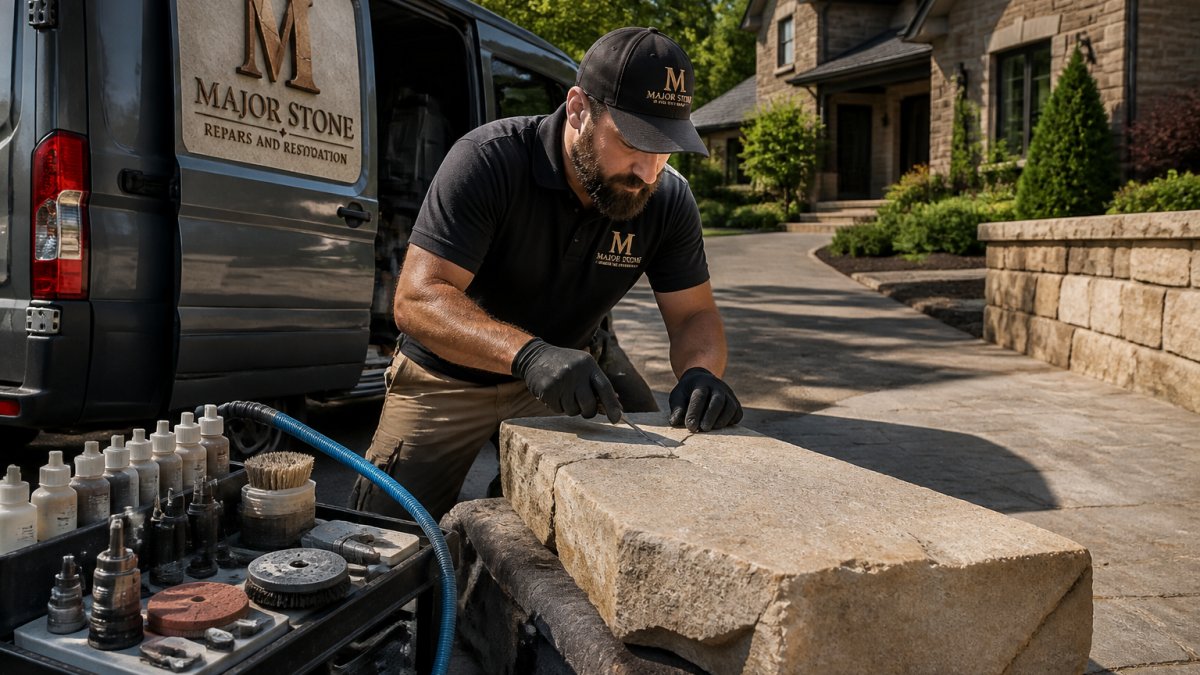
Professional quartz countertop restoration services repair damage to engineered quartz surfaces in place, without removing the slab.
At Major Stone Repairs and Restoration, we've spent more than 20 years working stone in the field, and quartz generates the most confusion.
Here's the honest list of what restoration can realistically address:
- Chips and small gouges along edges and sink cutouts
- Surface scratches, from light scuffing to deeper marks
- Dull, hazy, or chalky finishes caused by abrasive cleaners
A restoration technician assesses the damage first, then matches resin to the slab's color and pattern before any filler goes in.
Where Quartz Repairs Hit Their Limits
Quartz is roughly 90 percent ground stone bound with resin. That resin content sets a hard ceiling on what repair can achieve.
Deep cracks that run through the slab usually cannot be bonded reliably, because the structural failure is internal.
A common mistake is assuming every chip is a simple fill.
Watch out: DIY epoxy kits sold for quartz repairs often cure to a slightly different sheen than the surrounding surface, and the mismatch shows under kitchen lighting.
Quartz Countertop Repair Cost: What Drives the Number
Quartz countertop repair cost depends on damage type, quantity, slab accessibility, and whether the work includes sealing or seam repair.
We price on-site because the variables only become clear in person. Here is what actually moves the number:
| Cost Driver | Why It Matters |
|---|---|
| Number of damaged areas | Each chip or scratch is a separate repair sequence |
| Damage depth | Surface scuffs polish out; gouges need filler and blending |
| Slab color and pattern | Heavy veining demands more precise color matching |
| Location on the counter | Edge and sink-area repairs take longer than field repairs |
| Seam or sink involvement | Adds disassembly, cleaning, and re-caulking time |
| Sealing afterward | DryTreat application adds protection and a warranty |
For a rough sense of the market, Rose Restoration's countertop restoration page publishes a typical range of $10 to $20 per square foot for restoration work, which gives you a benchmark for comparison shopping.
The cost-effective solution is almost always repair. Replacement means demolition, templating, fabrication, and reinstallation, plus days without a working kitchen.
Quartz Countertop Chip Repair: What a Real Fix Looks Like
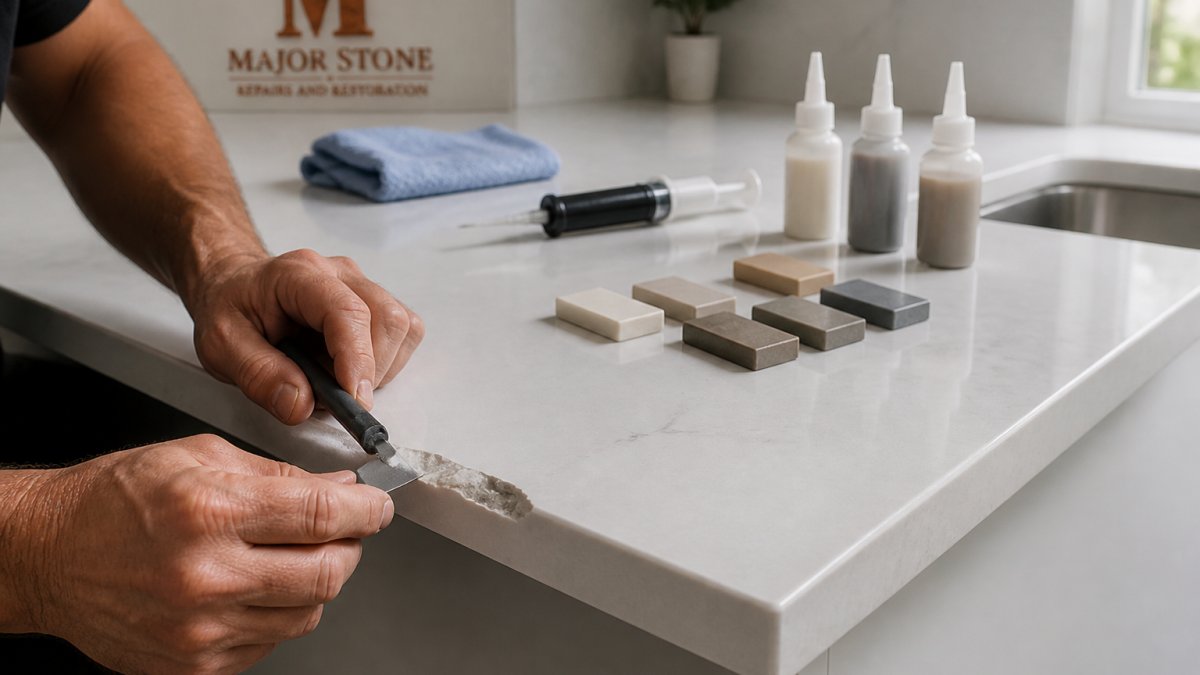
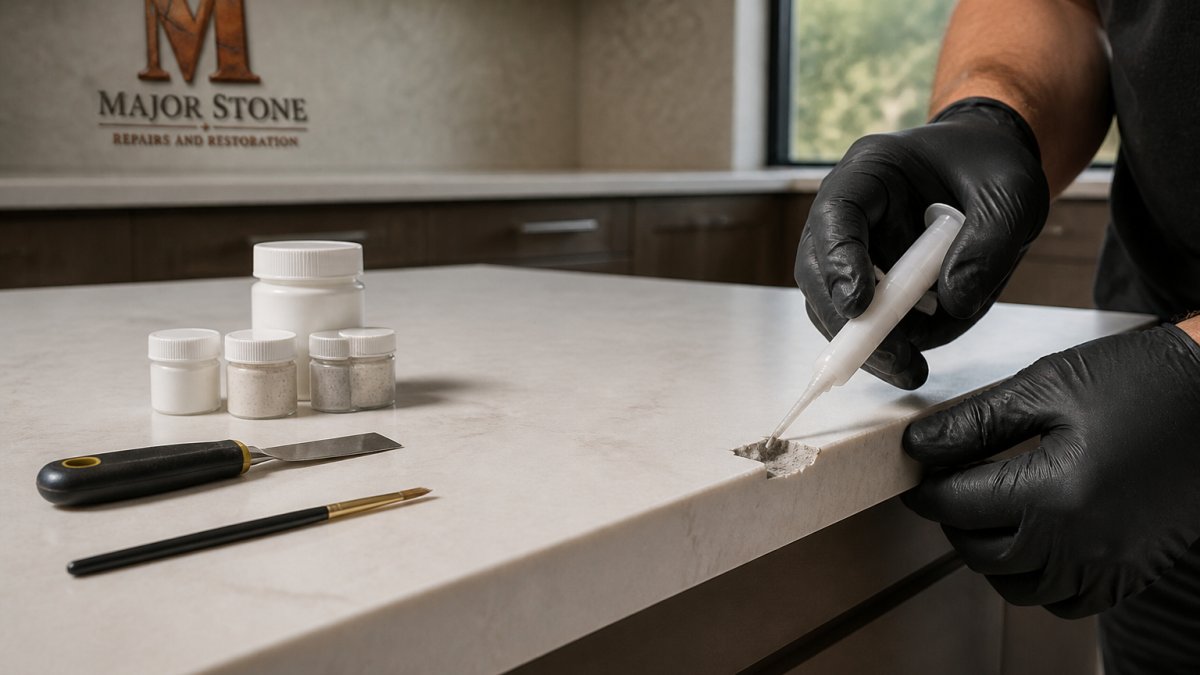
Quartz countertop chip repair is a multi-stage process: clean the damaged area, build up color-matched resin in thin layers, cure each layer, then sand and polish the patch until it blends into the surrounding finish.
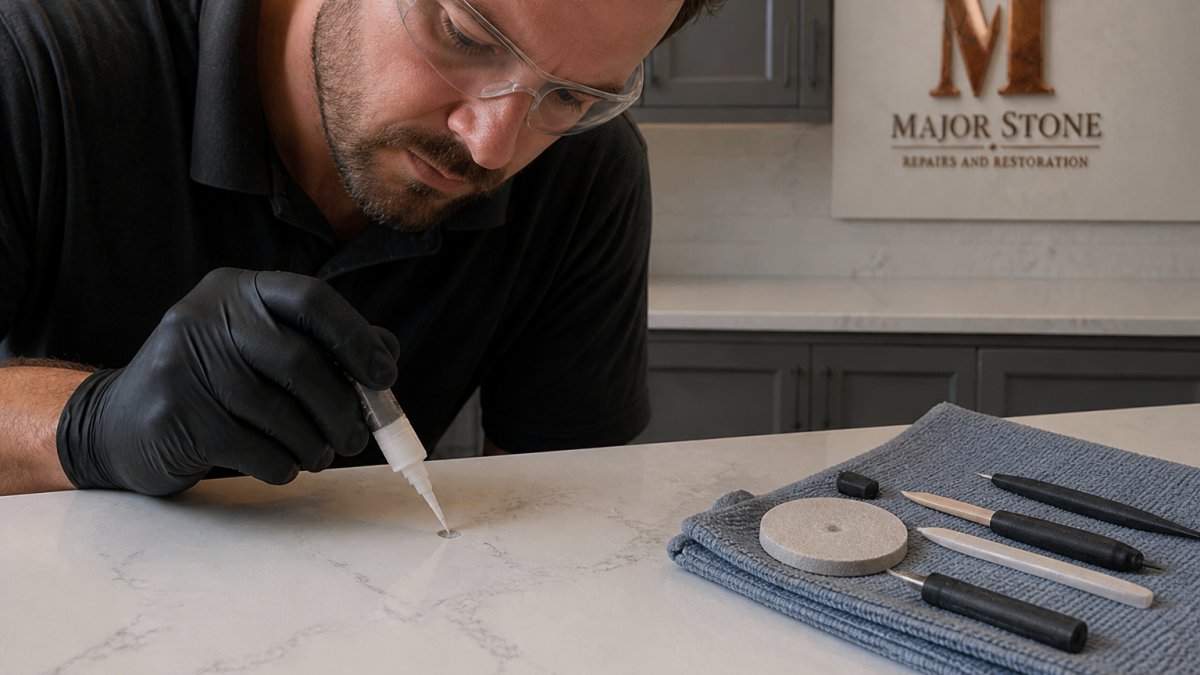
The sequence we follow on a chip repair looks like this:
- Assess the chip depth and whether the edge needs structural backing
- Clean out loose material and any old adhesive
- Mix resin to match the slab's base color and pattern
- Apply in thin layers, curing between each
- Sand progressively finer grits to level the patch
- Polish to restore the original sheen
- Seal the repaired area
For a deeper walkthrough of the full process, professional stone chip repair covers how the work is done, when to call a specialist, and how to prevent repeat damage.
Dull Quartz Countertop Repair: Bringing the Finish Back
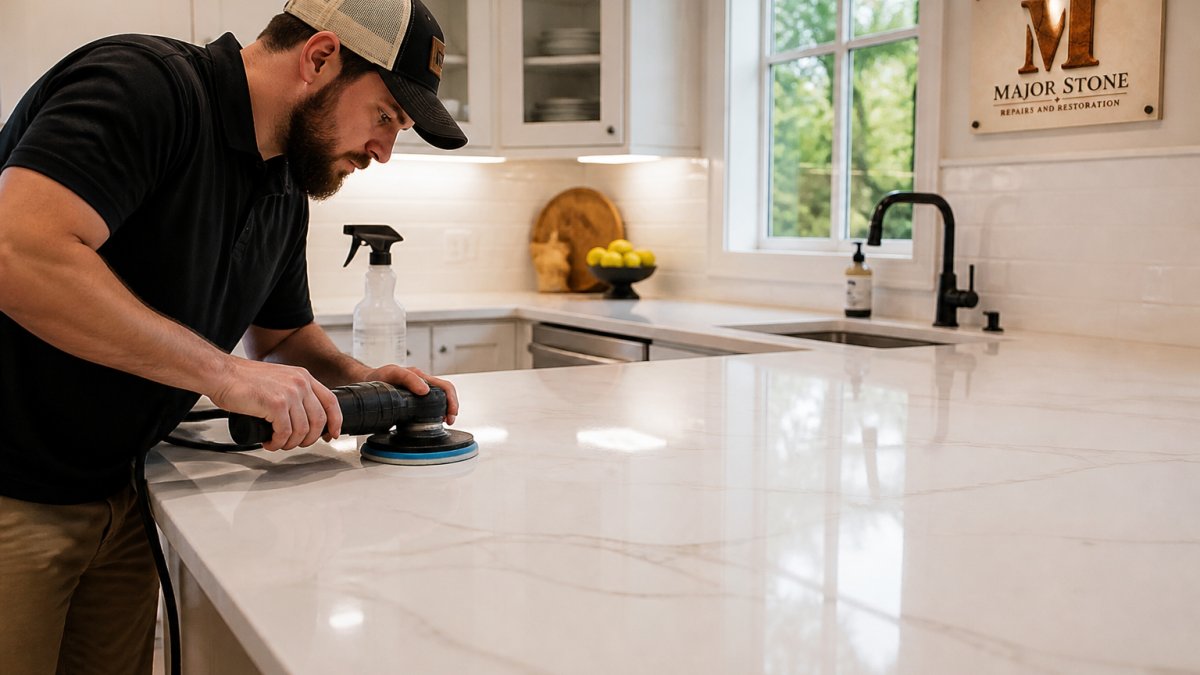
Dull quartz countertop repair restores the surface sheen through mechanical polishing, not coatings or "restorer" sprays.
What most guides miss is the cause. Most dull quartz we see was not worn out by daily use. It was scratched by the wrong cleaner.
Polishing is a controlled removal of material. A technician works through grits, checking the reflection at each stage, and stops when the finish matches the untouched areas.
If your counter has lost its luster across a large area, this is a job for a clean and polish service rather than a spot fix, because consistency across the whole surface matters more than any single patch.
Quartz Countertop Stain Removal and Seam Work
Quartz countertop stain removal works best when the stain is identified first, because oil, rust, wine, and hard-water marks each respond to different methods.
Seam repair is the other half of this work, and homeowners underestimate it. A failed seam is not just cosmetic: water migrating into a seam can damage the cabinet below and loosen the sink bond over time.
Our seam work involves cleaning out the old caulk completely, drying the joint, and re-filling with a color-matched flexible sealant that moves with the counter. Sinks get the same treatment: sink reattachment addresses a loose or leaking basin before it becomes a cabinet repair.
Repair or Replace? A Decision Framework for Quartz
Most guides tell you repair is cheaper and leave it there. That is true often enough to be misleading. The framework below is built on the factors that actually flip the decision: damage severity, location, slab age, and the real cost of replacement.
Step 1: Classify the damage
| Damage type | Typical path | Why |
|---|---|---|
| Surface scratches and scuffing | Polish and refinish | The damage is in the finish, not the slab |
| Dull or hazy finish across an area | Polish and refinish | Micro-scratches from abrasive cleaners are removable by progressive abrasion |
| Chips and small gouges at edges or sink cutouts | Repair with structural backing | Cosmetic filler alone fails at stress points |
| Stains that have not penetrated deeply | Stain removal | Identify the stain first; oil, rust, wine, and hard water respond to different methods |
| Failed seam or loose sink | Repair | Cleaning and re-sealing is far cheaper than replacement |
| Crack running through the slab | Assess in person; replacement may be needed | Internal structural failure usually cannot be bonded reliably |
| Heat damage with discoloration below the surface | Assess in person; often permanent | Resin scorching is not a surface problem |
| Widespread structural failure across multiple areas | Replacement likely more sensible | Repair cost approaches replacement without restoring integrity |
Step 2: Weigh the cost math
Replacement is not just the slab. It includes demolition, templating, fabrication, reinstallation, and days your kitchen is unusable. Repair is priced per damaged area or by refinishing scope, and the cost-effective answer is almost always repair when the damage is at the surface.
The decision flips when the repair scope approaches the replacement number, or when the slab has failed structurally and a repair would be cosmetic over a compromised base.
Step 3: Factor in age, location, and access
- Age. A newer slab with localized damage is a clear repair. An older slab with multiple failing areas may be nearing the point where replacement is the better long-term spend.
- Location. Damage at edges, sink cutouts, and seams carries more risk because those areas take stress. Field damage in the middle of the counter is usually the most straightforward repair.
- Access. A counter worked on in place avoids the removal and reinstallation risk of an in-shop refinish, a real cost difference, not a convenience.
The rule we use
If the damage is at the surface, repair it. If the slab itself has failed structurally, replacement enters the conversation. Everything in between is an on-site judgment call, and any provider who skips the inspection is skipping the judgment.
For a detailed side-by-side of both paths, repairing versus replacing kitchen countertops lays out costs, damage severity, and lifespan so you can make the call with numbers in front of you.
How the Leading Restoration Providers Compare
Most pages in this category are either a single company's service page or a directory list of local names with phone numbers. Neither helps you compare providers on the things that actually determine whether a chip disappears or turns into a visible scar. The comparison below is organized around the criteria that matter, with the trade-offs stated plainly.
The criteria that separate providers
| Criterion | What to look for | Why it changes the outcome |
|---|---|---|
| Service model | Mobile on-site vs. in-shop vs. hybrid | On-site avoids slab removal and reinstallation risk; in-shop can handle full-slab refinishing but requires transport |
| Quartz-specific experience | Documented quartz jobs, not just granite or marble | Engineered quartz's resin content changes cure, color matching, and heat sensitivity |
| Color-matching method | Custom resin mixed to the slab vs. generic filler | A generic filler on a veined or speckled slab is visible under kitchen lighting |
| Sealing and warranty | Manufacturer-specified sealer with a written performance warranty | Defines who is responsible if the seal underperforms |
| Pricing transparency | On-site estimate vs. published range vs. phone quote | Phone quotes without seeing the surface are guesses |
| Insurance and credentials | Liability coverage and manufacturer accreditation | Separates a restoration firm from a handyman with a polishing pad |
| Aftercare guidance | Written care instructions and a return-visit policy | Prevents the same damage from recurring |
How the common provider types stack up
- Mobile on-site restoration firms. Work on the slab where it sits, the right model for chips, seams, sink areas, and localized dullness. Large-area refinishing is limited by what can be done in a kitchen rather than a workshop. Best for homeowners who want to avoid demolition and days without a counter.
- In-shop refinishing operations. Can hone and polish a full slab under controlled conditions, but require removal and reinstallation, adding cost and risk. Best for full-surface restoration on a slab already being removed or pieces that can be transported.
- General handyman and remodeling outfits. May offer 'countertop repair' as an add-on. Ask specifically for quartz jobs and color-matching examples; the risk is a cosmetic patch that fails under daily use.
A note on our own position
We are a mobile, on-site restoration firm. We come to you, work on the slab where it sits, and do not ask you to transport a countertop. That model lets us serve homeowners, contractors, and property managers without a workshop drop-off, and it is also why we are candid that full-slab refinishing is a different job from localized repair. See the standard we hold ourselves to in our restoration portfolio, which shows the kind of before-and-after work we consider a finished job.
Credentials, Warranties, and What to Ask Before Booking
Credentials are the fastest way to separate a real restoration provider from a handyman with a polishing pad. Ask these questions before anyone touches your counter:
- Are you accredited by a recognized sealer manufacturer?
- Do you carry liability insurance?
- Will you provide a written warranty on sealing?
We're an accredited DryTreat applicator, so our sealing work follows a manufacturer's specification and carries a performance warranty, a defined standard and a named party responsible if the seal underperforms.
If you want the full picture of how we work and what we commit to, why choose Major Stone Repairs and Restoration sets out our experience, our process, and our warranty terms.
Get Your Free On-Site Estimate
The gap between a counter you tolerate and a counter you're proud of is usually one visit.
We bring more than 20 years of stoneworking experience to your kitchen, along with color-matched resin work, DryTreat sealing, and a performance warranty on our sealing solutions.
Contact us to schedule your free on-site estimate and get a straight answer on what your quartz actually needs.
Frequently Asked Questions
Can quartz countertops be professionally restored?
Yes, within limits. Quartz countertop restoration can fix chips, cracks, dull patches, stains, and failed seams, usually in place without removing the slab. The catch is the surface: engineered quartz has a resin binder and a factory finish, so aggressive grinding can change how the surface looks and wears. A technician should assess the damage first and tell you honestly what will blend and what will not. Deep burns or large breaks often point to replacement instead.
How much does professional quartz countertop repair cost?
Pricing depends on the damage type, the number of repair spots, the countertop area, access, and whether sealing is included, so most providers quote after seeing the surface. Pricing depends on several factors, so the most reliable figure comes from an on-site estimate or a current quote from Major Stone Repairs and Restoration. Ask for an itemized quote covering chip repair, polishing, seam work, and sealing separately so you can compare quotes fairly.
How do professionals repair chips in quartz countertops?
A technician cleans the chip, applies a color-matched resin or filler in thin layers, cures it, then sands and polishes the patch until it sits flush with the surrounding surface. Matching the pattern and sheen is the hard part, which is why quartz countertop chip repair is a job for someone with stone experience rather than a hardware-store kit. Repair time depends on the size and location of the damage.
Can dull quartz countertops be polished back to a shine?
Often, yes. Dullness usually comes from abrasive cleaners, scouring pads, or years of buildup, and honing and polishing can restore the sheen. How much comes back depends on how deep the dulling goes and whether the factory finish has been worn through. A dull quartz countertop repair visit should include a test patch so you can see the result before the full job is done.
Is quartz restoration different from granite restoration?
Yes. Granite is natural stone and can be ground, honed, and re-polished more freely because the color runs through the material. Quartz is engineered with resin, so heat and aggressive abrasives do more damage, and repairs rely on matching resin rather than revealing fresh stone. That difference is why quartz countertop restoration calls for a technician who works with engineered stone regularly, not just natural stone.
Most quartz damage is repairable, and the decision comes down to whether the surface or the slab has failed. Major Stone Repairs and Restoration handles both assessments in person, with mobile service, accredited DryTreat sealing, and a performance warranty behind the work. Get started with Major Stone Repairs and Restoration and see your counter restored rather than replaced.