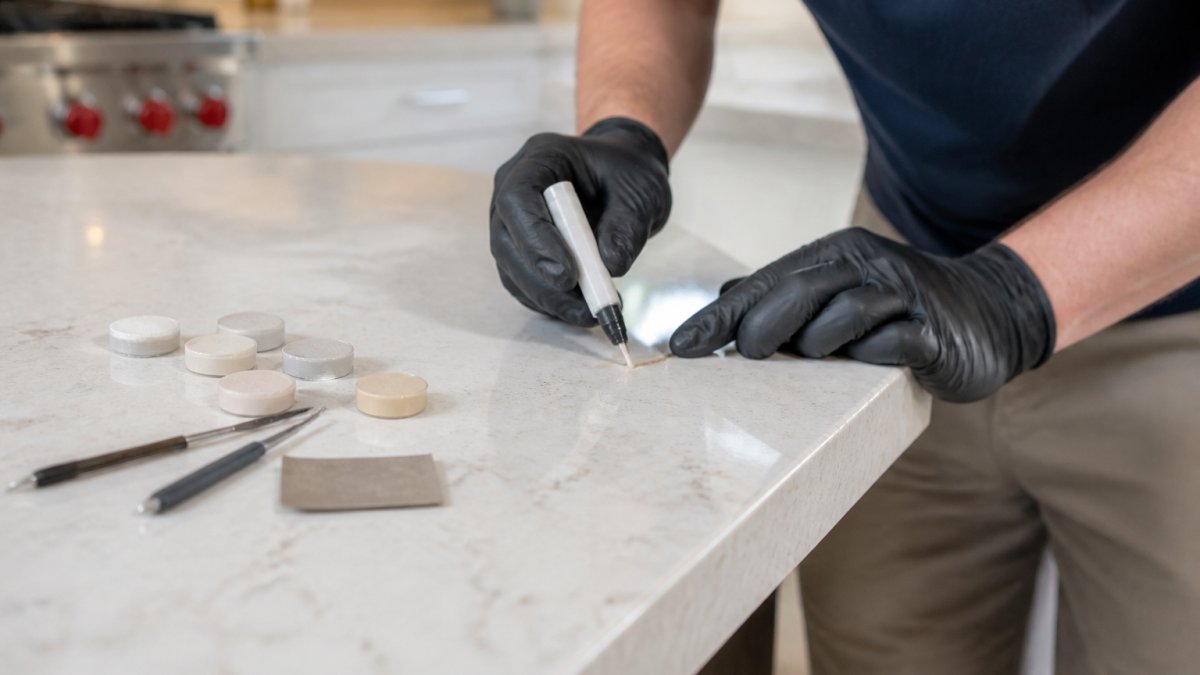
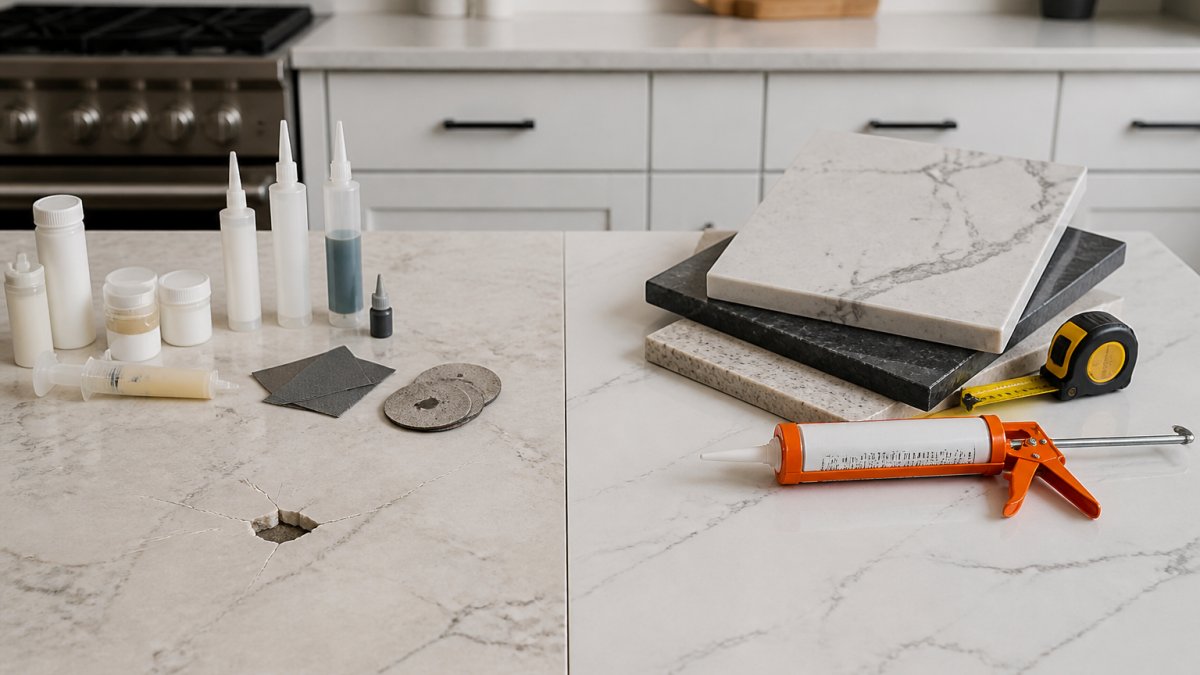
 blog
Repairing vs Replacing Kitchen Countertops: 2026 Guide
Table of Contents
- Repairing vs Replacing Kitchen Countertops: The Core Decision
- Signs Your Countertop Is a Candidate for Repair
- When Countertop Replacement Is the Better Choice
- Kitchen Countertop Repair Cost: What Drives the Number
- Kitchen Countertop Replacement Cost: The Full Scope
- Material-by-Material Repairability Guide
- Lifecycle Cost, Durability, and Disposal
- Frequently Asked Questions
Last Updated: October 19, 2026
Repairing vs Replacing Kitchen Countertops: The Core Decision
Repairing vs replacing kitchen countertops comes down to one question: how much of the surface is actually failing?
That matters because replacement is a demolition project. Repair is a maintenance task. Knowing which one you are facing saves money and weeks of disruption.
Here is the short version. Small, isolated damage on a structurally sound top favors repair. Widespread cracking, a failing substrate, or a material at the end of its life favors replacement.
Repair vs Replace at a Glance
| Factor | Repair | Replace |
|---|---|---|
| Best when | Damage is isolated and shallow | Damage is widespread or structural |
| Disruption | Usually a single visit | Tear-out, fabrication, install |
| Timeline | Days | Weeks |
| Keeps existing material | Yes | No |
| Handles color or style change | No | Yes |
The 50% Cost Rule of Thumb
The 50% rule is a simple filter. If a repair estimate approaches half the cost of a full replacement, replacement usually wins.
Why? Because a repair buys you time, not a new lifespan. Once you cross that halfway mark, you are paying new-countertop money for a patched surface. Ask for both numbers before you decide. Any honest provider will give you a repair quote and a replacement range side by side.
Signs Your Countertop Is a Candidate for Repair
A countertop is a good repair candidate when the damage is local and the slab is solid. Look for these signals:
- Small chips along edges or around the sink
- Hairline cracks that have not spread
- Scratches and dull patches from years of use
- Stains that sit in the surface rather than deep inside
- Seam separation at a joint that can be re-bonded
- Burn marks from a hot pan set down too fast
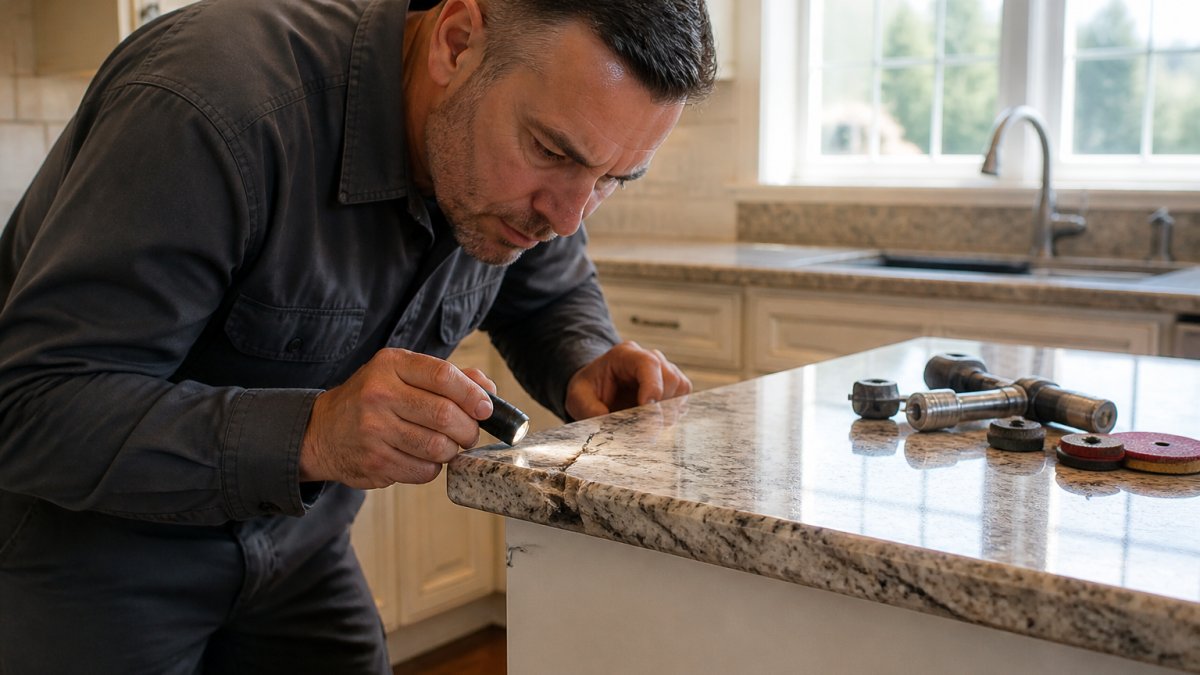
The key word is local. One chip is a repair. Twelve chips across three slabs is a pattern, and patterns usually mean the material is tired. We tell homeowners to walk the whole kitchen with a flashlight at a low angle.
When Countertop Replacement Is the Better Choice
Replacement wins when the damage is structural or the material has reached the end of its service life. Three situations push the decision that way:
- Cracks that run through the slab or radiate from a corner
- A soft or sagging substrate under the stone
- Damage across multiple slabs rather than one spot
Structural and Material Red Flags
Some damage cannot be patched honestly. Watch for:
- Cracks that reappear after a previous repair
- Water damage or swelling in the cabinet base
- Laminate that has lifted, delaminated, or burned through
- Stone that has cracked along a seam more than once
If the substrate is moving, any repair you make will fail. Fix the cause first, or replace.
Kitchen Countertop Repair Cost: What Drives the Number
Kitchen countertop repair cost depends on four things: the material, the size of the damage, the access to the spot, and whether the surface needs refinishing afterward. Refinishing an entire top adds another layer on top of that.
Here is how those factors stack up:
- Material: natural stone and quartz take more skill than laminate.
- Damage size: a chip is quick; a long crack is a process.
- Location: edges and sink cutouts are harder to reach than open field.
- Finish: matching a polished surface takes more work than a matte one. High-gloss polished stone requires a multi-grit polish to blend the repair; honed or matte finishes are more forgiving and usually cost less.
Itemized Repair Cost Breakdown
A repair quote is rarely one line. Most estimates break into:
- Assessment and setup: often waived or rolled into the job.
- Cleaning and drying: critical for cracks that have taken in water; skipping this is why repairs fail.
- Filling and color-matching: the skill-intensive step; this is where material type drives cost most.
- Leveling and polishing: blending the repair to the surrounding finish.
- Sealing: a final protective coat, sometimes priced separately.
Ask for the quote broken out this way. A single lump-sum number hides whether you are paying for proper color-matching or a quick fill that will show under kitchen light.
What Pushes a Repair Toward Replacement Pricing
When a repair estimate approaches half the cost of a full replacement, the 50% rule says replacement usually wins. In practice, that threshold is often crossed when:
- The crack reappears after a prior repair
- The damage spans multiple slabs rather than one spot
- The substrate under the stone is soft or moving
- The finish needs full refinishing on top of the structural repair
We quote each job after seeing the damage, because two cracks that look identical in photos can need very different work. Pricing depends on the scope, so we give a free on-site estimate rather than a phone number.
Kitchen Countertop Replacement Cost: The Full Scope
Kitchen countertop replacement cost covers far more than the slab. The full scope usually includes:
- Tear-out and disposal of the old top
- New fabrication, including cutting for the sink and cooktop
- Installation and seam setting
- Plumbing reconnection at the sink
- Backsplash work, if the old one comes off with the counter
That list is why replacement quotes climb fast. The stone is only part of the bill. Labor, fabrication, and the disruption of a kitchen that is unusable for days all count.
Replacement does have one clear advantage: you get a new surface, a new lifespan, and a chance to change the color or layout. If the kitchen is being remodeled anyway, that timing often makes replacement the smarter call.
Material-by-Material Repairability Guide
Not every material repairs the same way, and the decision to repair or replace often turns on what the counter is made of rather than how big the damage looks. This is where most guides stay vague, so here is the practical breakdown by material, what repairs well, what does not, and where the replacement threshold sits.
| Material | Repairable? | Typical repair methods | Replace when |
|---|---|---|---|
| Granite | Yes | Chip and crack fill with color-matched epoxy, polishing, seam re-bonding | Crack runs through the slab or reappears after repair |
| Marble | Yes | Etch removal, honing and polishing, chip fill | Structural crack or widespread etching across the top |
| Quartz | Yes, with care | Specialist chip fill and polish; seam repair | Heat damage or a crack along a seam that will not hold |
| Laminate | Limited | Small chip fill only | Lifting, delamination, or burn-through |
| Solid surface | Yes | Sanding and blending, seam renewal, chip fill | Substrate failure or widespread cracking |
| Butcher block | Yes | Sanding, re-oiling, spot repair | Rot, deep water damage, or delamination at joints |
How to Repair a Chipped Countertop by Material
Learning how to repair a chipped countertop starts with the material. On granite and quartz, a chip is cleaned, filled with a color-matched compound, leveled, and polished back to the surrounding finish. On marble, the same process plus refinishing restores the sheen. On solid surface, the chip is sanded and blended. On butcher block, a chip is sanded out and the area re-oiled.
This is precision work. A mismatched fill shows up under kitchen light every time.
Repair or Replace: A Material-by-Material Decision Guide
Use the material to narrow the decision before you look at cost:
- Granite: the most repairable natural stone. Chips and hairline cracks fill and color-match well, and refinishing restores dull or scratched surfaces. Replace when a crack runs through the slab or has already failed a prior repair.
- Marble: etches and dull spots refinish cleanly, so appearance damage is usually a repair. Replace when the damage is structural or the etching covers the whole top and refinishing will not recover it.
- Quartz: repairable with care, but heat and seams are the weak points. A chip is a specialist fill; a seam that has opened and will not re-bond often means replacement of that section.
- Laminate: the least repairable common surface. Small chips can be filled, but lifting, delamination, or burn-through means replace, there is no refinishing path.
- Solid surface: sandable and blendable, and seams can be renewed. This is one of the most repair-friendly materials; replacement is usually about style or substrate failure, not the surface itself.
- Butcher block: sanding and re-oiling handle most wear. Replace when rot or deep water damage has reached the joints.
Countertop Refinishing and Restoration Options
Countertop refinishing is the middle path between a spot repair and a full replacement. It covers:
- Honing and polishing to remove scratches and dullness
- Etch removal on marble and other calcium-based stone
- Sealing to protect against stains and wear
Restoration brings back the natural luster without tearing anything out. As an accredited DryTreat applicator, we apply advanced sealers backed by a performance warranty, which matters if you have spent years using ordinary cleaners on granite.
Lifecycle Cost, Durability, and Disposal
Think in decades, not dollars. A well-sealed stone top that gets routine care can serve a kitchen for a very long time.
There is also a hidden cost to waiting. A small crack that takes in water can stain the stone and weaken the edge.
This is the part most homeowners miss: maintenance is cheaper than either repair or replacement.
Our mobile specialists come to you, so there is no hauling a heavy slab anywhere.
A damaged countertop is a decision, not a disaster. The wrong call is guessing.
Frequently Asked Questions
How do you know whether a countertop can be repaired or needs replacing?
Start with the damage itself. Small chips, scratches, dull spots, stains, and hairline cracks are usually repairable, especially on natural stone and quartz. Large cracks that run through the slab, seam separation that keeps returning, soft or crumbling substrate, or water damage underneath point toward replacement. The 50% rule helps too: if a professional countertop repair quote approaches half the cost of a full replacement, replacement often makes more financial sense. A professional assessment confirms which side of the line your countertop is on.
How much does kitchen countertop repair cost compared with kitchen countertop replacement cost?
Kitchen countertop repair cost depends on the damage type, the material, and how many spots need attention. A single chip or scratch costs far less than a multi-point restoration or a crack that needs structural work. Kitchen countertop replacement cost runs much higher because it includes tear-out, fabrication, new material, installation, and often plumbing and backsplash work. Exact figures vary by provider and material, so ask for a written estimate that itemizes the repair scope versus a full replacement quote before deciding.
Can cracked quartz, granite, or marble countertops be repaired?
In most cases, yes. Granite and marble cracks can be filled and blended so the repair is hard to spot, and quartz chips can be repaired with color-matched material. The deciding factor is severity. Hairline and surface-level cracks respond well to countertop restoration, while cracks that go through the slab or keep reopening may signal a structural problem. A stone specialist can tell you whether the crack is cosmetic or a sign the countertop is failing before you commit to either repair or replacement.
Can countertop refinishing fix scratches, stains, or dullness?
Countertop refinishing and restoration are built for exactly those problems. Honing and polishing bring back the surface luster on granite, marble, and quartz, and professional sealing helps block future staining. Refinishing will not fix a crack that runs through the slab or a countertop that has lost structural integrity. If your stone is sound but looks tired, refinishing is usually far cheaper than replacement and can be done on site. Ask for a free estimate to confirm what refinishing can achieve on your surface.