 how-to
How to Restore Dull Granite Countertops: Step-by-Step
Last Updated: October 23, 2026
Quick Summary
To restore dull granite countertops, first clean the surface with a pH-neutral stone cleaner to remove buildup, then hand-polish with a granite-safe paste or powder using circular motions with a soft cloth, and finally buff dry with a microfiber cloth to bring up the gloss. If the dullness is caused by sealer breakdown, reseal after polishing to lock in the shine and protect the stone.
- Dullness is caused by soap and mineral deposits, acidic cleaner etching, or sealer breakdown, each requires a different fix.
- Use only pH-neutral, stone-safe cleaners; regular household cleaners strip the protective sealer and damage granite.
- Hand polishing works for light to moderate dullness; work in 2-foot by 2-foot sections using light pressure and overlapping circular motions.
- Always dry granite thoroughly with a microfiber cloth after cleaning, as wet granite looks dull.
- Reseal after polishing only if the water test shows the sealer is failing; sealer protects but does not restore shine.
Table of Contents
- Why Granite Countertops Lose Their Shine
- Diagnose the Cause of Dullness Before You Start
- What You'll Need Before Restoring Dull Granite
- How to Clean Granite Countertops and Make Them Shine
- How to Remove Cloudiness from Granite
- How to Polish Granite Countertops by Hand
- Granite Countertop Resealing to Lock in Shine
- Common Mistakes to Avoid When Restoring Granite
- Frequently Asked Questions
Why Granite Countertops Lose Their Shine
Granite starts with a natural gloss that fades over time. Understanding why helps you fix it correctly.
Dullness happens for three reasons: soap and mineral deposits build up, acidic cleaners etch the stone, and the sealer breaks down or wears away.
Most homeowners don't realize they're using the wrong cleaners. Regular household cleaners strip the protective sealer, leaving the stone vulnerable and dull.
Diagnose the Cause of Dullness Before You Start
Before you polish, identify the cause. Different causes need different fixes, and treating the wrong problem wastes time and money.
Soap Residue and Mineral Deposits
Soap residue and mineral deposits create a cloudy film, the most common cause of dull granite. Run your hand across it: slippery or chalky means buildup. Hard water leaves white or gray spots; soap leaves a thin film that catches light. This is easiest to fix, a deep clean usually restores shine immediately.
Light Etching from Acidic Cleaners
Acidic cleaners damage granite permanently. Vinegar, lemon juice, and bathroom cleaners etch the surface, leaving dull, rough patches. Run your fingernail across an etched area and you'll feel a slight groove. The damage is in the stone itself, so etching requires polishing, not just cleaning.
Sealer Breakdown or Absorption Issues
Granite needs sealer to stay protected. When sealer wears out, water absorbs into the stone.
Test your sealer with water. Drop a small amount on the countertop. If it beads up, the sealer is working.
A broken sealer means you'll need to reseal after polishing. This locks in the shine and protects against future damage.
What You'll Need Before Restoring Dull Granite
Gather these supplies first:
- Granite-safe cleaner (pH-neutral, no vinegar or bleach)
- Warm water
- Soft cloths or microfiber cloths
Use only products labeled safe for natural stone. Regular household cleaners damage granite. Stone-safe cleaners protect while they clean.
How to Clean Granite Countertops and Make Them Shine
Cleaning is the first step to restore dull granite countertops. You can't polish over dirt and buildup.
Remove Surface Buildup and Residue
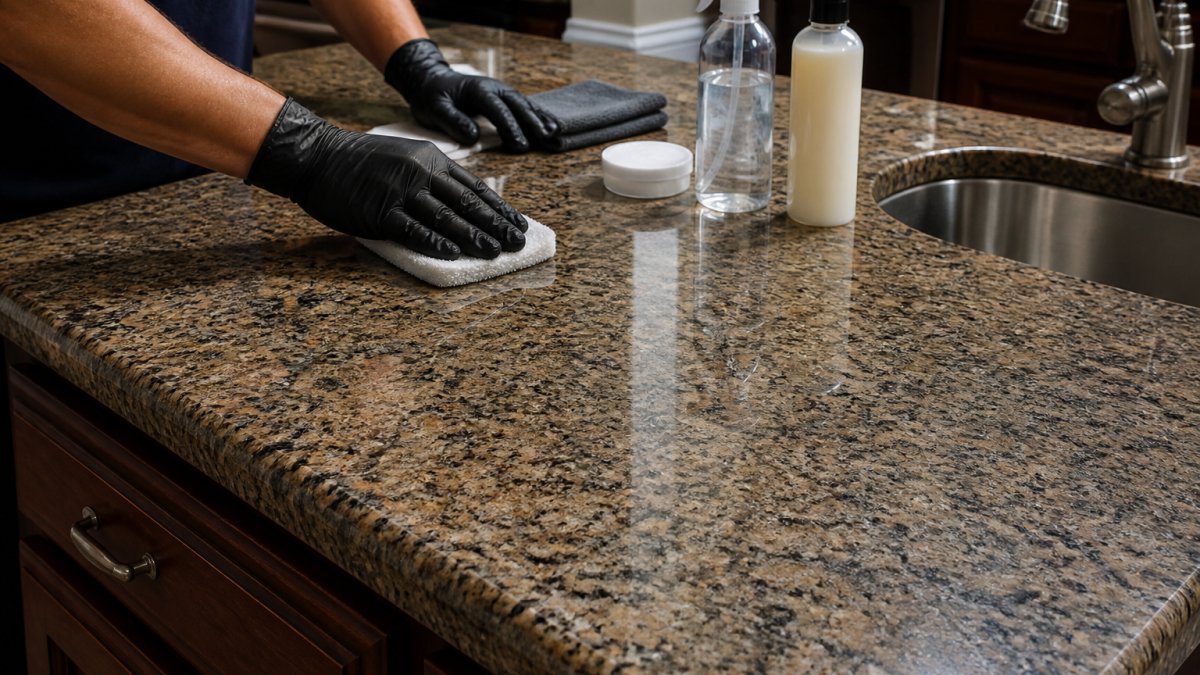
Mix warm water with a stone-safe cleaner per the product instructions and spray it on the countertop. Let it sit for 30 seconds, then wipe with a soft cloth in circular motions, gentle pressure works better than hard scrubbing. Pay attention to corners and edges, where buildup collects, and wipe until the cloth comes away clean.
Rinse and Dry Thoroughly
Rinsing removes all cleaner residue, left-behind cleaner creates a new film. Rinse with clean warm water and a fresh cloth until no soapy water remains, then dry immediately with a clean, dry microfiber cloth, pressing firmly to absorb all moisture. Wet granite looks dull; dry granite begins to show its natural shine.
How to Remove Cloudiness from Granite
Cloudiness means buildup or sealer breakdown, leaving the surface hazy or milky. If cleaning didn't remove it, the sealer is failing and water is absorbing into the stone, which requires polishing and resealing. A professional polish fills microscopic pits and smooths the surface so light reflects evenly again. DIY polishing works for light dullness; heavy cloudiness or etching may need professional restoration.
How to Polish Granite Countertops by Hand
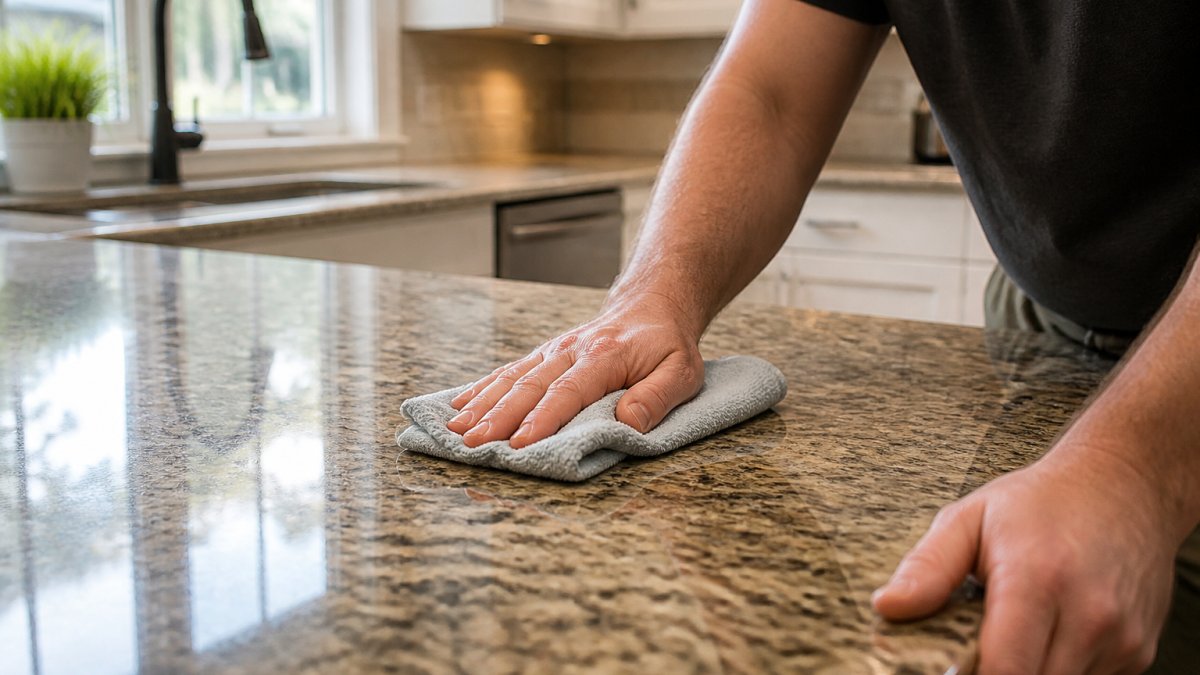
Hand polishing restores shine to lightly to moderately dull surfaces by leveling the microscopic high points left by etching and wear so light reflects evenly again.
Match the Polish to the Finish
Before you buy anything, identify your finish. Most kitchen granite is polished (high gloss, mirror-like), but some is honed (matte) or leathered (textured). Polishing powder is formulated for polished granite and can leave a hazy film on honed or leathered stone, so check the fabricator paperwork or test in a hidden corner first.
Choose the Right Polish Form
Three forms are common:
- Powder (oxalic-acid-based or cerium-oxide blends): Mixed with water into a thin slurry. Best for restoring gloss on polished granite and removing light etch marks. Requires rinsing and buffing. Can be messy.
- Paste or cream: Pre-mixed, easier to control, less likely to dry unevenly. Good for spot treatment. Usually less aggressive than powder.
- Liquid polish/spray: The mildest option. Best for maintenance shine between deep polishes, not for correcting etch or wear.
For a first DIY attempt on light dullness, start with a paste or liquid polish. Move to powder only if the surface still looks flat after cleaning and a paste pass.
Hand-Polishing Technique, Step by Step
- Test patch first. Pick a 1-foot by 1-foot area in a corner or behind an appliance, complete the full process there, and inspect under raking light (a flashlight held at a low angle) before committing to the whole counter.
- Work in small sections. A 2-foot by 2-foot area is manageable; larger areas dry out before you finish and leave streaks.
- Apply sparingly. A quarter-sized amount of paste or a light dusting of powder mixed with a few drops of water is enough for a 2-foot section. More product means more residue, not more shine.
- Use the right pad. A soft microfiber cloth or felt polishing pad is appropriate. Avoid Scotch-Brite-style scouring pads, green scrubbers, and anything labeled "heavy duty", they micro-scratch polished granite.
- Work in overlapping circles. Apply light to moderate pressure; you are burnishing a surface, not scrubbing a stain. Keep the product slightly damp, if it dries to a chalky powder, add a spritz of water.
- Time per section. Most practitioners find 2-3 minutes per 2-foot section is enough for a paste or liquid polish. Powder slurries may need a second pass.
- Watch for darkening. Paste and powder often darken as they work into pores, which is normal. If the surface looks uniformly hazy rather than glossy, you are using too much product or too little pressure.
Buffing to Bring Up the Gloss
Buffing is where the shine actually appears. After polishing, wipe away excess product with a clean, damp microfiber cloth, then buff dry with a second clean, dry microfiber cloth.
- Use light pressure and circular motions, overlapping each pass.
- Change cloths as soon as they load up with residue, a dirty cloth smears product back onto the stone.
- Buff the entire counter evenly. Uneven buffing is the most common cause of blotchy results.
When Hand Polishing Is Not Enough
Stop and call a professional if any of these are true:
- The etch marks catch a fingernail (deep etching, not surface dullness).
- The dullness returns within a few days of polishing (usually a sealer or finish problem).
- You see swirl marks or haze after buffing that were not there before (abrasive too aggressive or pad too rough).
Professional honing and polishing uses diamond abrasives in a controlled grit sequence (typically 50 through 3000 grit) and a variable-speed wet polisher, equipment and technique not practical to replicate by hand. Attempting it is how small dull spots become expensive repairs.
Granite Countertop Resealing to Lock in Shine
Sealing is the most misunderstood step in granite restoration. A sealer does not restore shine, and it does not fix etching, scratches, or a worn factory polish. It slows liquid absorption into the stone's pores, helping prevent stains and reducing the rate at which dullness returns, protection for the work you just did, not the work itself.
Test Whether You Actually Need to Reseal
The water test is the standard field check, but it has nuance most guides skip.
- Clean and dry a 6-inch area in an inconspicuous spot (behind the sink, near the backsplash).
- Place a quarter-sized puddle of water on the surface.
- Wait 10-15 minutes, not 5. Many sealers are partially effective and will bead for the first few minutes before absorbing.
- Observe: if the water still beads and the stone underneath has not darkened, the sealer is working. If the water spreads, soaks in, or the stone darkens, the sealer is failing or absent.
Repeat the test in two or three locations. Sealer wears unevenly, high-traffic zones near the sink and cooktop often fail first while the rest of the counter still beads. Spot resealing those zones is often enough; a full reseal may not be necessary.
What Sealing Can and Cannot Fix
Sealing can help with:
- Slowing water and oil absorption
- Reducing the risk of wine, oil, and citrus stains setting in
- Making everyday cleanup easier
Sealing cannot fix:
- Etch marks from acidic cleaners or spills (physical damage to the stone surface)
- Scratches, chips, or cracks
- A worn or sanded factory polish
If your dullness is caused by any of the "cannot fix" items, resealing will not restore shine, polish or professional restoration comes first.
Application and Aftercare
Apply sealer only to a clean, dry, polished surface. Most penetrating granite sealers require two thin coats.
- Apply thin. Use a soft cloth or applicator pad in small sections; a thin, even coat is more effective than a heavy one.
- Wipe off excess immediately. Excess sealer that dries on the surface creates a cloudy film, the exact problem you are trying to avoid.
- Respect cure time. Most sealers need 24-48 hours to cure fully. Avoid water, food prep, and cleaning during that window; check the label, since solvent-based sealers cure faster and some water-based ones slower.
Reseal Timing and Maintenance Routine
There is no universal reseal interval. Manufacturer claims of "10-year sealer" assume ideal conditions; real-world kitchens with daily cooking, acidic foods, and frequent cleaning wear sealer faster.
A practical routine:
- Weekly: Clean with a pH-neutral stone cleaner and a microfiber cloth. Dry thoroughly.
- Monthly: Run the water test in high-traffic zones.
- Every 6-12 months: Reassess. Reseal high-traffic zones as needed; full reseal typically every 1-3 years depending on stone porosity, sealer type, and use.
If the water test shows the sealer is fine but the counter is still dull, the problem is surface-level, buildup, etching, or a worn polish, and resealing is the wrong tool. Clean, polish, then reassess.
Common Mistakes to Avoid When Restoring Granite
Mistakes waste time and can damage stone.
Using acidic cleaners. Vinegar, lemon, and bathroom cleaners etch granite.
Scrubbing too hard. Aggressive scrubbing scratches the surface.
Skipping the dry step. Wet granite looks dull.
Applying too much polish. Excess paste creates buildup.
Resealing without cleaning first. Sealer won't bond over dirt.
Ignoring etching damage. If acidic cleaners have etched the surface, polishing won't fully restore it; deep etching may need professional restoration.
Dull granite doesn't mean you need to replace your countertops.
Frequently Asked Questions
Why do granite countertops lose their shine?
Granite countertops lose shine due to soap residue, mineral deposits from hard water, light etching from acidic cleaners, or sealer breakdown over time. Daily use and improper cleaning products gradually dull the natural gloss. A water test on an inconspicuous area reveals whether the sealer has failed, if water beads up, the sealer is intact; if it soaks in, resealing is needed to restore protection and shine.
How do you remove cloudiness from granite?
Cloudiness often results from soap buildup or mineral deposits. Clean the surface with a granite-safe cleaner and warm water, then dry thoroughly with a clean cloth. For stubborn cloudiness, use a polishing powder or paste designed for natural stone, applying it with a microfiber cloth in circular motions. If cloudiness persists after cleaning and polishing, the sealer may have failed and resealing may be necessary to restore clarity and shine.
Can you polish granite countertops by hand?
Yes, hand polishing is effective for restoring shine to granite. Use a stone-safe polishing powder or paste, apply it to a small section, and buff with a microfiber cloth or soft polishing pad using circular motions. Work in manageable areas to ensure even coverage. Hand polishing works best for light dullness; heavy etching or sealer failure may require professional restoration or resealing for lasting results.
Does resealing granite restore its shine?
Resealing helps protect the stone surface, but only if dullness is caused by sealer breakdown. If dullness results from etching or buildup, you must clean and polish first, then reseal. A water test determines if resealing is needed, if water no longer beads on the surface, the sealer has worn away. Professional resealing with a penetrating sealer provides lasting protection.